




The data-driven swap
Turning customer insights into category growth

“We have to marry the data with the Walmart customer, to figure out the why behind the what.”
How do you know you’re maximizing your revenue potential? That’s the question Pratt Retail Specialties set out to answer. So they looked to Scintilla insights to develop a data-driven framework for analyzing shelf space.
See how combining sales data and customer insights through Scintilla helped Pratt drive huge sales gains from a compact assortment.
The opportunity: Is the shelf working?
Due to in-store optimization efforts, the entire Moving & Storage category was set to move to a new department in Walmart stores. The move would land Pratt with a new Walmart merchandising team, and performance expectations were high.
Pratt wouldn’t be caught flat-footed. To prepare, the team launched a six-month, 500-store test in Scintilla to probe their assortment for opportunities. Their goal was to use limited shelf space as efficiently as possible: maximal revenue from minimal space.
The approach: A multipronged analytical framework
Evaluating their assortment methodically from the ground up, Pratt developed a four-part framework to improve shelf productivity. It paired Scintilla insights with physical shelf space metrics to make sure every item on the shelf would meet customer needs.
Stage 1: Shelf productivity
Their first step was to use Channel Performance Report Builder to run a Shelf Productivity Analysis. This enabled Pratt to quantify the value of their shelf space, translating a fuzzy concept into hard data.
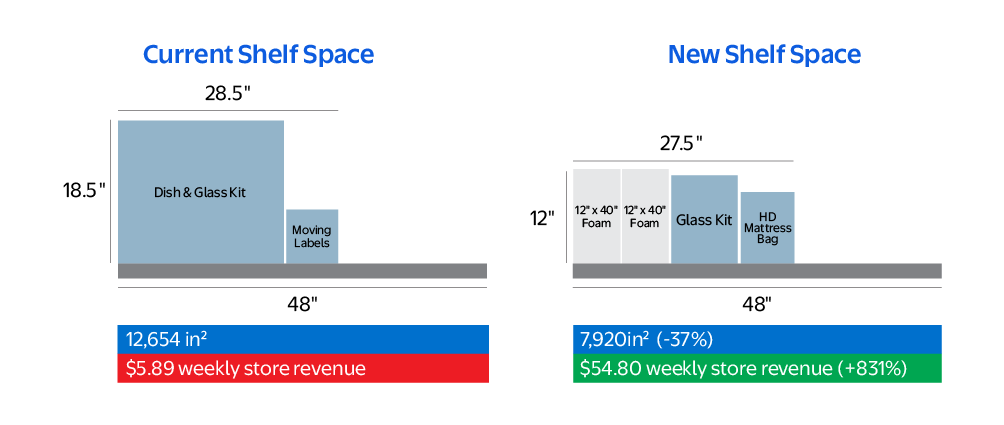
They quickly found an area for improvement: their Moving Labels and Dish & Glass Kit, which occupied a combined 12,654 square inches of shelf space, generated just $5.89 per store each week.
Stage 2: Customer perception
Underperforming products were a sign that Pratt’s assortment was out of step with customer needs. To recalibrate, Pratt sourced insights directly from customers via Customer Perception and from reviews on Walmart.com.
Their findings began to explain why sales velocity was low. The surveys revealed that customer preference on packing materials was split between options like foam, packing paper, and bubble wrap, making the all-in-one Dish & Glass Kit too rigid to satisfy everyone. Price was another concern—94% of customers said they’d pay no more than $15 for a glass packing kit, while Pratt’s was priced at $16.98.
Online reviews for other products also showed a clear gap in the market for a heavy-duty mattress bag, which Pratt could include in their reimagined assortment.
Stage 3: Planning the move
So far, Pratt had blended quantitative and qualitative insights to confidently assess their assortment. Next they would put those insights into action.
They refreshed their assortment to fill the gaps and meet the needs they identified, replacing the sluggish sellers with a more compact Glass Kit, a Heavy Duty Mattress Bag, and new Foam Rolls to provide packing flexibility.
The new lineup fit neatly into a compact footprint, occupying 37% less shelf space than the original Dish & Glass Kit and Moving Labels had. All that was left to do was see how Walmart shoppers responded.
The results: A story of explosive growth
When the new products hit shelves, Pratt commenced stage 4 of their analytical framework: performance tracking.
Results from Shopper Behavior and Channel Performance suggested that the new lineup was significantly more efficient than the old. Despite its reduced footprint, it generated an incredible 831% more weekly revenue per store as customers readily took to the new offerings.
Each product made its own contributions. The Heavy Duty Mattress Bag generated 716% more revenue per store than the Moving Labels previously in its space, while the new, smaller Glass Kit outperformed its predecessor by 466%.
All told, the new lineup represented an enormous improvement over the old: Weekly store revenue per square inch increased by 1,387%. The increased sales added an extra 412% in incremental annual POS dollars, all while freeing up 13 inches of horizontal shelf space.
