



The evolution of Omni Commerce
Accelerating category demand by uncovering shifts in shoppers’ habits

With Scintilla, we could better understand opportunities to unlock even more digital growth with Walmart.
As Walmart’s digital business grew, Kraft Heinz and their Walmart merchant saw an opportunity to make sauces and condiments more relevant online. With category sales and digital penetration rising at double-digit rates, they partnered to use Scintilla to better understand changing customer behavior, identify gaps in the digital shopping experience, and uncover new opportunities for growth.
The opportunity: Keep pace with rapid digital adoption
Online grocery was creating new demand for sauces and condiments, but it was also changing how customers shopped the category. Kraft Heinz and their Walmart merchant needed to understand what was driving performance, where the online experience could improve, and how to better meet evolving customer needs.
Their key question: Could strong digital growth be masking underlying risk?
Working with their Walmart merchant, Kraft Heinz used Scintilla to look beyond strong sales numbers and identify opportunities to strengthen the category online. They set out to test a hypothesis: With the right investment and activation, they could sustain healthy digital momentum across the category.
The approach: Identify opportunities across the digital shelf
To investigate the opportunity, Kraft Heinz partnered with the dunnhumby Applied Data Science team to analyze Shopper Behavior data and understand what happens when customers add online grocery shopping to their routine. They defined two groups:
- Customers who shopped only in-store before and after the analysis period
- Customers who shopped in-store before the analysis period and then added online grocery shopping to their routine in the post-period
Insights revealed that 8% of condiments customers migrated online during the analysis period. Those shoppers were also younger, higher-income, more affluent, and more loyal to the category. However, after adding online grocery shopping, they devoted a slightly smaller share of their total grocery spend to sauces and condiments.
Building on those findings, Kraft Heinz and their Walmart merchant applied familiar in-store management principles to evaluate the digital shopping experience. They assessed two fundamentals: findability and visibility.
Findability: Can shoppers find what they need?
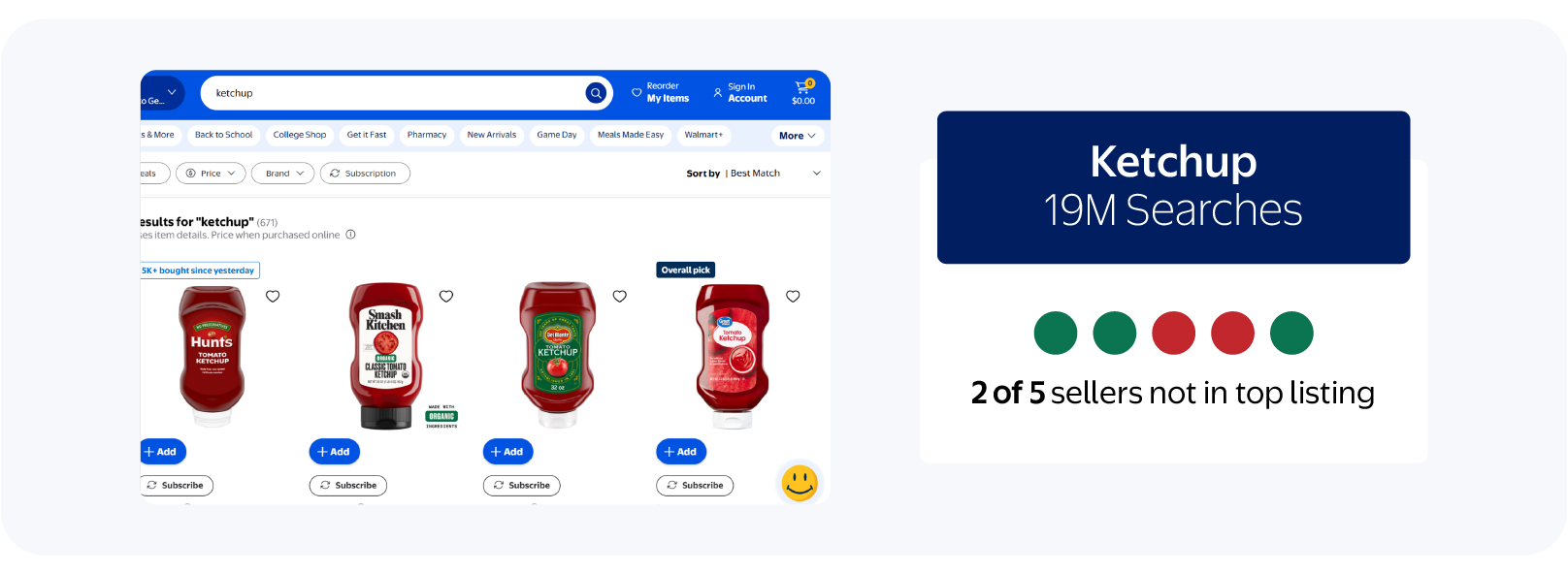
Digital Landscapes insights showed that 63% of Walmart add-to-cart traffic comes from search. Kraft Heinz examined key condiment searches and found that some top-selling products were missing from search results. For ketchup alone, which generates 19 million annual searches, two of the five top sellers didn't appear in the top Walmart online listings.
Using the Shopper Behavior Basket Affinity report, Kraft Heinz also identified opportunities to connect complementary categories. Canned tuna and mayonnaise, for example, are often purchased together, but canned seafood search takeovers focused only on tuna. Kraft Heinz learned that bringing condiments into these experiences could give shoppers a more complete meal solution.
Visibility: Can shoppers see relevant products?
Kraft Heinz also assessed visibility across visual navigation, which usually guides consumers down the decision journey. They found that listing results did not always align with shopper needs. For example, shoppers selecting vegan mayonnaise could be shown items containing egg. This created added friction as shoppers tried to narrow results based on dietary preferences and allergens.
The analysis also uncovered occasions where condiments were missing from the digital experience. A backyard BBQ cookout carousel featured buns, hot dogs, burgers, and chips, but left out the Sauces and Condiments category.
Customer Perception research reinforced the need to get these moments right as one in three online Walmart shoppers reported that they believe grocery shopping is stressful.
Test relevance in an agentic shopping experience
Finally, Kraft Heinz explored Agentic Commerce by asking Sparky to plan a Memorial Day cookout. Sparky recommended items from the Sauces and Condiments category, but the suggested products did not match the pack sizes and formats shoppers would need for a cookout. This opened another opportunity for Kraft Heinz: Digital relevance is not only about suggesting the right category, but also about helping shoppers find the right products, packs, and formats for the occasion.
The results: A clear path to strong digital sales
By combining Scintilla insights with their shared category expertise, Kraft Heinz and their Walmart merchant developed a clearer understanding of how online shopping was changing the Sauces and Condiments category—and where to focus next.
Together, they identified opportunities to improve customer targeting, build stronger shopper solutions, refine site merchandising and placement, and focus on the highest-value categories.
The findings gave Kraft Heinz and Walmart a more informed approach to strengthening category relevance online, improving the shopping experience, and identifying future growth opportunities.
